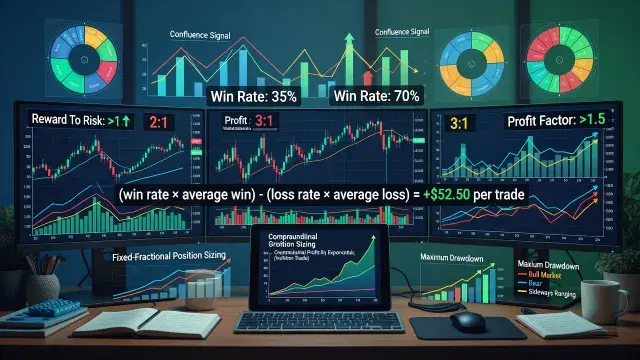
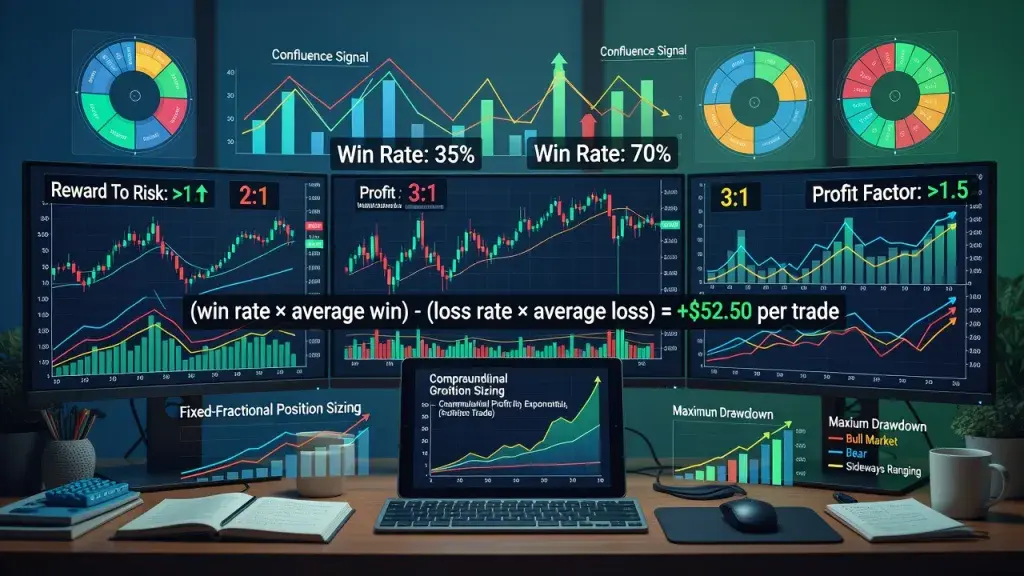
A trader who wins 70% of the time can still lose money over a year, while a trader who wins only 35% of trades can compound wealth steadily. This is the paradox that separates amateurs from professionals: win rate alone tells you almost nothing about profitability. What matters is the relationship between how often you win, how much you win when you're right, and how much you lose when you're wrong. Confuse these variables and you build a strategy that feels good but bleeds capital.
Most retail traders chase win rate because it satisfies a psychological need to be "right." Professional risk managers chase something else entirely - the mathematical expectation of a system played out over hundreds of trades. Somewhere between these two mindsets lies the actual path to sustainable returns. For those who enjoy testing probability-based systems in a lower-stakes environment before applying similar logic to markets, exploring a title like goal max win can offer an intuitive feel for how variance and payout ratios interact, even though the mechanics differ from trading itself.
This piece breaks down the actual math behind win rate optimization, explains why maximizing expected value is the only defensible framework for long-term decision-making, and shows how to calibrate a system to extract the highest achievable returns without inflating risk beyond what the strategy can survive.
Understanding the True Relationship Between Win Rate and Profitability
Win rate is the percentage of trades that close in profit. It is the single most misunderstood metric in trading because it ignores magnitude entirely. A system can be profitable with a 30% win rate if the average winner is four times larger than the average loser. Conversely, a system with an 80% win rate can destroy an account if the rare losses are catastrophic relative to the frequent small wins.
Why High Win Rates Can Still Produce Losses
Strategies built around high win rates often rely on capturing small, frequent gains while occasionally absorbing a large loss - a pattern common in strategies that sell options premium or scalp tight ranges. The failure mode is predictable: one outlier event wipes out dozens of prior wins. This is not a flaw in probability; it is a flaw in position sizing and risk-reward design.
Why Low Win Rates Can Still Be Highly Profitable
Trend-following systems typically win less than half the time. Their profitability comes from letting winners run far longer than losers are allowed to develop. A 35% win rate paired with a 3:1 reward-to-risk ratio produces a strongly positive expectation, even though the trader is "wrong" more often than "right."
The Role of Sample Size in Judging Any Win Rate
A win rate calculated from twenty trades is statistical noise. Meaningful conclusions require hundreds of data points across varied market conditions. Traders who abandon a sound strategy after a short losing streak are often reacting to normal variance, not to a broken edge.
The Mathematics of Maximizing Expected Value
Expected value (EV) is the average outcome an investor can anticipate per trade if the same setup were repeated indefinitely. It is calculated as: (win rate × average win) minus (loss rate × average loss). Every serious trading decision should be filtered through this equation before capital is committed.
Breaking Down the Expected Value Formula
Consider a strategy with a 45% win rate, an average win of $300, and an average loss of $150. The expected value per trade is (0.45 × 300) − (0.55 × 150) = 135 − 82.50 = $52.50. That positive number, repeated across a large sample, is what produces long-term account growth - not the win rate in isolation.
How Reward-to-Risk Ratios Change the Equation
Adjusting the reward-to-risk ratio shifts the minimum win rate required for profitability. A 2:1 ratio needs only a 34% win rate to break even; a 1:1 ratio needs 50%. Understanding this threshold lets traders evaluate whether a strategy's win rate is actually sufficient for its risk structure, rather than judging it against an arbitrary benchmark.
Common Errors When Calculating Expected Value
Traders frequently miscalculate EV by using cherry-picked trades, ignoring commissions and slippage, or averaging results across incompatible market regimes. An honest EV calculation demands a large, unfiltered dataset and realistic transaction costs baked into every entry and exit.
- Use at least 100-200 trades before trusting an EV calculation
- Include all costs: spreads, commissions, slippage
- Separate results by market condition (trending vs. ranging)
- Recalculate EV periodically as market behavior shifts
Win Rate Optimization: Techniques That Actually Work
Win rate optimization is not about forcing a higher percentage of winning trades at any cost. It is about refining entry criteria, filters, and timing so that the strategy's natural edge is expressed more consistently, without distorting the reward-to-risk profile that made the system viable in the first place.
Refining Entry Criteria Without Overfitting
Adding filters - volume confirmation, volatility thresholds, time-of-day restrictions - can genuinely improve win rate by eliminating low-probability setups. The danger is overfitting: tuning parameters so precisely to historical data that the strategy fails on new, unseen price action. A robust filter should make intuitive sense independent of the backtest that validated it.
Using Confluence to Improve Trade Selection
Combining multiple independent signals - trend direction, momentum, support and resistance - tends to raise win rate more reliably than optimizing a single indicator. Confluence works because it filters out noise-driven signals, leaving only setups where several independent forces align.
Adjusting Exit Rules to Lock In Higher Win Rates
Tightening stop-loss placement or taking partial profits earlier can raise win rate, but this often shrinks average win size proportionally. Every exit rule change should be tested for its net effect on expected value, not judged solely on whether it produces more green trades.
Trading Strategy Performance Metrics Beyond Win Rate
Evaluating trading strategy performance requires a broader toolkit than win rate and even expected value alone. Drawdown, consistency, and risk-adjusted return all determine whether a strategy is livable in practice, not just profitable on paper.
Maximum Drawdown and Its Impact on Long-Term Viability
A strategy can have excellent expected value and still be unusable if its maximum drawdown exceeds what a trader can psychologically or financially tolerate. Drawdown measures the peak-to-trough decline in account equity and reveals how much pain is required to capture the strategy's long-term edge.
Profit Factor and Its Relationship to Expected Value
Profit factor - gross profit divided by gross loss - offers a quick sanity check on system quality. A profit factor above 1.5 generally indicates a strategy with enough cushion to survive periods of below-average performance, while anything near 1.0 leaves little margin for error.
Consistency Across Market Regimes
A strategy that performs well only in trending markets and collapses during consolidation is fragile. Testing performance separately across bull, bear, and sideways conditions reveals whether the edge is structural or merely a byproduct of one favorable environment.
How to Maximize Profit Without Increasing Unacceptable Risk
The instinct to increase position size or trade frequency in pursuit of higher returns is understandable, but it frequently converts a sound strategy into an unsustainable one. Sustainable profit growth comes from disciplined scaling, not from abandoning risk controls.
Position Sizing as the Primary Lever for Profit Growth
Fixed-fractional position sizing - risking a consistent percentage of capital per trade - allows account growth to compound naturally without exposing the trader to ruin during a losing streak. Increasing size after a string of wins, rather than arbitrarily, keeps risk proportional to actual account equity.
Compounding Effects on Long-Term Returns
Small, consistent edges compound dramatically over time. A strategy generating a modest 1.5% average monthly return, reinvested systematically, produces far more capital growth over several years than a high-variance approach that occasionally posts spectacular months but suffers periodic account resets.
Avoiding the Trap of Overtrading for Higher Win Rates
Increasing trade frequency in search of more winning trades often dilutes strategy quality, since the additional trades typically fall outside the original edge's criteria. Overtrading inflates transaction costs and emotional fatigue while rarely improving actual expected value.
Achieving the Highest Achievable Returns Through Systematic Testing
The ceiling on returns for any given strategy is not arbitrary - it is defined by the interaction of win rate, reward-to-risk ratio, position sizing, and market conditions. Systematic testing reveals where that ceiling actually sits, rather than relying on guesswork or overconfidence.
Backtesting Protocols That Produce Reliable Results
Reliable backtesting requires out-of-sample data, realistic cost assumptions, and testing across multiple market cycles. A strategy validated only on a single bull run tells you almost nothing about its behavior during a prolonged downturn or sideways chop.
Forward Testing and Live Performance Validation
Paper trading and small-size live testing expose execution issues - slippage, latency, emotional interference - that backtests cannot capture. A strategy should demonstrate consistency in forward testing before capital allocation is increased.
Iterative Refinement Without Curve-Fitting
Adjustments should be made cautiously, one variable at a time, with each change validated against a fresh dataset. Strategies refined too aggressively against historical data tend to perform beautifully in backtests and poorly in live markets - a mismatch that erodes confidence and capital simultaneously.
Frequently Asked Questions
Is a higher win rate always better for a trading strategy?
No. A higher win rate only matters in combination with the reward-to-risk ratio of each trade. A strategy with a lower win rate but a favorable ratio can generate stronger expected value than one with a high win rate and a poor ratio.
What win rate do I need to be profitable?
It depends entirely on your reward-to-risk ratio. With a 2:1 ratio, you need roughly 34% winners to break even; with a 1:1 ratio, you need close to 50%. Anything above that breakeven threshold, sustained over a large sample, produces positive expected value.
How many trades do I need before trusting my win rate statistics?
A minimum of 100 to 200 trades is generally required to draw meaningful conclusions, and even then results should be checked across different market conditions. Smaller samples are too vulnerable to random variance to reflect a strategy's true edge.
Can I improve win rate without hurting expected value?
Yes, through better trade selection filters and confluence-based entries rather than tighter stops or premature profit-taking. The key is testing whether the change improves expected value overall, not just the win percentage in isolation.
Why did my backtested strategy perform worse in live trading?
This usually stems from overfitting during backtesting, unrealistic cost assumptions, or execution factors like slippage and emotional deviation from the plan. Forward testing on smaller size before full deployment helps catch these discrepancies early.
How does position sizing affect long-term profitability?
Position sizing determines how quickly gains compound and how severely losing streaks affect the account. Fixed-fractional sizing tied to current equity allows sustainable growth while protecting against the risk of ruin during inevitable drawdowns.