
A three-card hand determines more money changing hands globally each night than most casino floor games combined. Teen Patti has moved from family gatherings and festival tables into digital platforms where real cash sits on the line, and with that shift comes a question most players never asked at home: what are the actual odds baked into the game you're playing? The answer lives in a single metric that casinos rarely explain in plain language.
Return to player percentages sound like technical jargon reserved for slot machine engineers, but they apply directly to how Teen Patti platforms are built and how they pay out over time. Before depositing real money into any digital version of this game, it helps to understand what teen patti RTP actually measures, how it differs from luck on a given night, and why two platforms offering the "same game" can behave very differently over thousands of hands. Players who take the time to check the mechanics behind a platform, such as reviewing details through teen patti rtp listings before committing funds, tend to make far more informed decisions than those who simply chase a winning streak.
This piece breaks down the mathematics, the payout structures, and the practical decisions that separate casual players from those who understand exactly what they're wagering against.
What RTP Actually Means in Teen Patti
Return to player is a percentage that represents how much of all wagered money a game is designed to pay back to players over a very large number of rounds. It is not a promise about any single session, and it is not a guarantee tied to any individual account. It's a statistical average calculated across millions of hands dealt by the underlying software.
The Mathematical Foundation
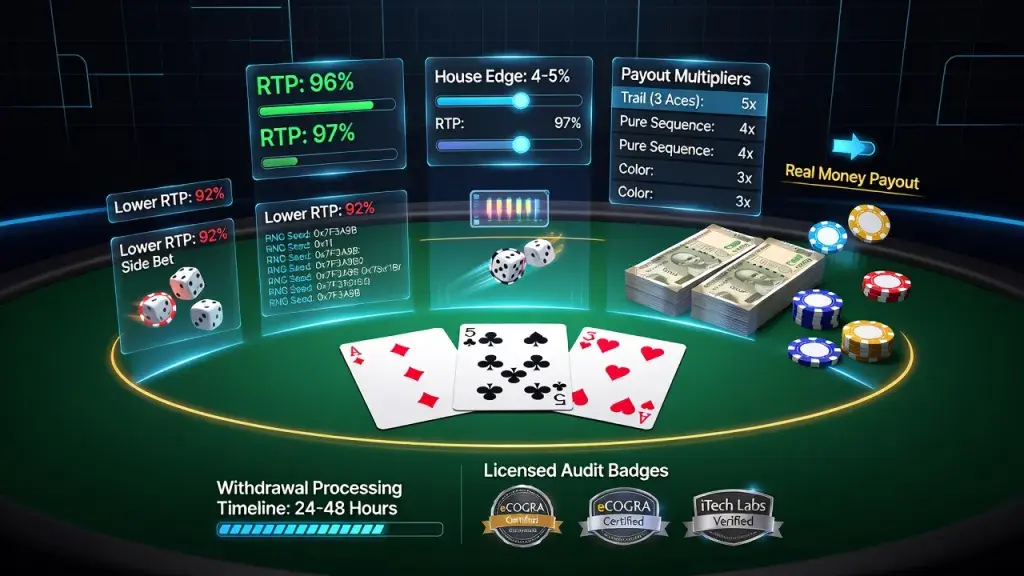
Every digital card game runs on a random number generator that determines card distribution. Developers calculate teen patti RTP by simulating enormous volumes of hands and measuring the ratio between total payouts and total wagers. If a platform states a 96% RTP, that means for every 100 units wagered across the full simulated sample, 96 units return to players collectively, while the remaining 4 units represent the house edge.
Why RTP Is Never a Short-Term Guarantee
A player can sit down for twenty hands and lose every single one on a game with a stated 97% return to player. The math only levels out across a statistically significant sample size, which for card games often means tens of thousands of rounds. Short sessions are dominated by variance, not by the underlying percentage.
How RTP Differs From House Edge
House edge and RTP are two sides of the same coin. If the RTP sits at 95%, the house edge is 5%. Neither figure changes based on betting patterns, bluffing skill, or table selection within a given game variant - they are fixed characteristics of the game's design.
- RTP is calculated before the game launches, using simulation data
- House edge represents the platform's structural advantage, not a fee charged per hand
- Neither figure accounts for bonus rounds, side bets, or promotional payouts unless specifically stated
How Teen Patti Payout Structures Are Built
Payout structure refers to how winnings are distributed based on hand rankings, pot size, and betting rounds - separate from, but connected to, the overall RTP calculation.
Standard Hand Rankings and Their Payout Weight
Trail (three of a kind) pays the highest multiplier, followed by pure sequence, sequence, color, pair, and high card. Because trail hands occur far less frequently than high card hands, platforms weight the payout multipliers accordingly to keep the overall teen patti RTP consistent with its stated figure.
Pot Limits and Boot Amounts
The initial boot amount and any pot limits directly shape how much a player can realistically win or lose per round. Lower boot tables produce smaller, more frequent payouts; higher stakes tables produce larger but less frequent swings, even though the underlying RTP percentage remains identical across both.
Side Bets and Bonus Payouts
Many platforms offer side bets - such as wagering on a pair or better before cards are dealt - that carry their own separate RTP, often lower than the main game. These side bets are frequently the least favorable part of the overall teen patti payout structure, despite offering flashy multipliers.
Teen Patti Real Money: What Changes When Stakes Are Real
Playing teen patti real money versions introduces variables that free-play or practice modes never test: withdrawal processing, deposit matching, and regulatory oversight.
Licensing and Fair Play Verification
Reputable real money platforms submit their random number generators to independent testing labs, which verify that the stated RTP matches actual game performance. Licensing bodies typically require these audits on a recurring basis, not just at launch.
Deposit Bonuses and Their Effect on Effective RTP
A deposit match bonus can temporarily raise the effective return a player experiences, since bonus funds increase the total amount in play without a matching increase in the player's own risk. However, wagering requirements attached to these bonuses often offset the benefit.
Withdrawal Terms and Real Payout Reliability
A platform's advertised RTP means little if withdrawal processes are slow, capped, or riddled with hidden conditions. Reliable teen patti real money platforms publish clear withdrawal timelines and minimum thresholds, and they honor them consistently.
Return to Player: Long-Term Player Expectations
Understanding teen patti return to player as a long-term concept, rather than a session-by-session promise, changes how a rational player approaches bankroll management.
Bankroll Management Against a Known RTP
Once a player knows the approximate house edge, they can calculate expected loss over a session of a given size. A 5% house edge on a hundred-hand session with moderate bets translates into a predictable expected loss range, even though individual outcomes remain unpredictable.
Session Length and Variance Exposure
Shorter sessions carry higher variance relative to the stated RTP - a player could easily finish up or down by a wide margin. Longer sessions gradually converge toward the platform's actual return to player figure, for better or worse.
Comparing RTP Across Multiple Platforms
Not all Teen Patti variants carry the same RTP, even within the same operator. Comparing published figures across platforms before committing significant funds is one of the few genuinely actionable steps a player can take to improve long-term outcomes.
- Check whether the platform publishes RTP figures publicly or only on request
- Compare RTP across different Teen Patti variants offered by the same operator
- Prioritize platforms audited by recognized independent testing agencies
Practical Strategies Based on RTP and Payout Data
Knowing the numbers is only useful if it changes behavior at the table.
Choosing Tables With Favorable Structures
Tables with lower rake or commission percentages effectively improve the player's realistic return, even when the base game RTP is identical. Rake compounds over many hands, so a seemingly small difference matters over a long session.
Avoiding Common RTP Misconceptions
A frequent mistake is assuming that a "hot" table or a recent losing streak affects future probabilities. Random number generators have no memory. Each hand is statistically independent of the last, regardless of what the previous twenty hands produced.
Setting Realistic Win and Loss Limits
Given a known house edge, setting a stop-loss and a target win amount before playing keeps decisions grounded in math rather than emotion. This single habit separates disciplined players from those who chase losses indefinitely.
Frequently Asked Questions
Is a higher teen patti RTP always better for players?
Generally yes, since a higher RTP means a lower house edge and better long-term expected returns. However, RTP alone doesn't account for variance, table rake, or withdrawal reliability, so it should be one factor among several when choosing where to play.
Can I verify a platform's stated RTP myself?
Direct verification usually requires access to independent audit reports, which licensed operators publish or make available on request. Playing a large sample of hands and tracking your own results can give a rough personal estimate, but it won't match the statistical precision of a lab audit.
Does RTP guarantee I'll win a certain amount back?
No. RTP describes an average outcome across a massive number of hands, not a guarantee for any individual player or session. You could play for hours and finish well above or below the stated percentage purely due to variance.
How does teen patti payout differ between hand types?
Rarer hands like trail and pure sequence pay significantly higher multipliers than common hands like high card, since they occur less frequently. This weighted structure is designed so the overall payout across all hand types aligns with the game's published RTP.
Are side bets worth playing given their RTP?
Side bets typically carry a lower RTP than the main game, meaning the house edge is steeper. They can add excitement, but relying on them as a primary strategy usually reduces long-term returns compared to focusing on standard hand play.
Does playing teen patti real money change the odds compared to free play?
The underlying odds and RTP structure are usually identical between free and real money modes on legitimate platforms, since both run on the same random number generator. What changes is the presence of actual financial risk, withdrawal considerations, and bonus terms that only apply to real money accounts.