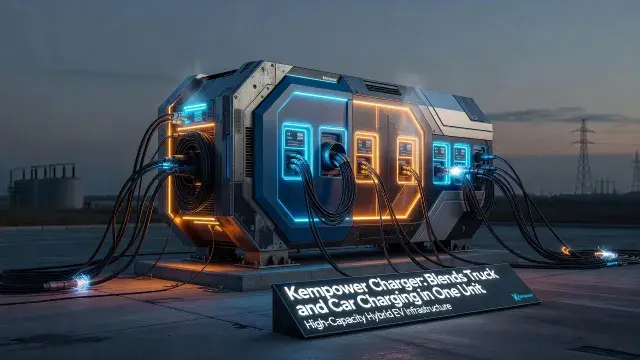
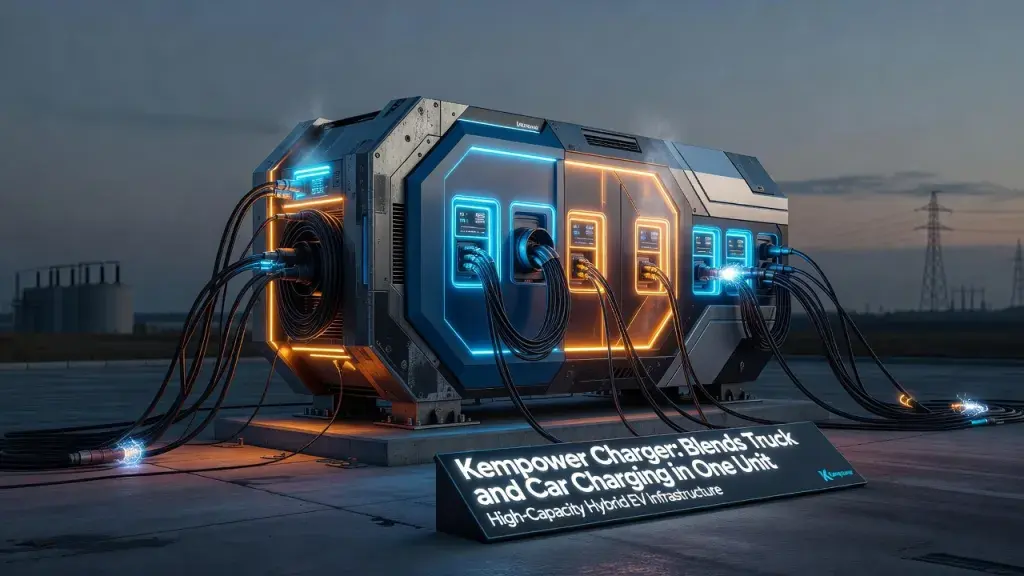
Kempower has introduced a charger designed to serve both electric cars and heavy-duty trucks from the same cabinet, a move that addresses one of the thorniest infrastructure questions facing the electric vehicle industry: how to build sites that work for today's vehicles and tomorrow's without paying for the same real estate twice. The Mega Satellite Flex, unveiled at the company's Unplug & Recharge event during ACT Expo, supports the established Combined Charging System standard at up to 560 kW and the emerging Megawatt Charging System at up to 1.2 MW.
The timing reflects a genuine fork in the road for charging technology. CCS has been the dominant plug for passenger EVs in North America and Europe for years, built around power levels that suit cars and light commercial vehicles. Heavy trucks are a different problem entirely: their batteries are larger, their schedules are tighter, and hauling operators cannot tolerate long dwell times at a charging site. MCS was developed specifically to deliver the kind of power that lets a truck add meaningful range in the time it takes a driver to take a mandated rest break. Just as this hardware question is being settled at the physical layer, the digital side of vehicle connectivity is facing its own scrutiny, with fleet operators increasingly relying on tools such as a commercial VPN service to protect telematics and payment data moving across charging networks. a commercial VPN service
Why One Dispenser for Two Vehicle Classes Matters
Building separate charging infrastructure for passenger vehicles and trucks has historically meant duplicating land, grid connections, and construction costs. A site owner installing car chargers today who later wants to serve trucks has typically faced a second, disruptive buildout. Kempower's pitch is that a single dispenser capable of both standards removes that later expense and lets a site owner capture revenue from whichever vehicles show up, car or truck, from the moment the equipment is switched on. That flexibility also extends to newer 800-volt electric vehicles, an architecture increasingly common in higher-end passenger cars and trucks because it allows faster charging without excessive current.
The Hardware Behind the Claim
The specifications point to genuine engineering trade-offs rather than marketing language alone. The unit is rated for up to 1,500 amps on the MCS side and 700 amps for CCS, current levels that demand careful thermal management and cable design. The CCS cable runs 5 meters, long enough to comfortably reach a passenger car's charging port regardless of parking position, while the MCS cable is a shorter 2.7 meters, reflecting the more standardized coupling position on truck cabs. An optional payment terminal allows the dispenser to function as a public-access point rather than a fleet-only asset. Because the Mega Satellite Flex works within Kempower's existing distributed charging architecture, operators who already run Kempower systems can add the unit without redesigning power distribution across a site.
What Comes Next
The push toward megawatt charging is still in its early stages industry-wide, with truck manufacturers and charging companies aligning around MCS as a shared standard rather than a proprietary approach. That coordination matters because fragmented charging standards have historically slowed EV adoption in every vehicle class. Kempower says the Mega Satellite Flex will go on sale in North America and Europe in July 2026, giving fleet operators and charging site developers a concrete window to plan deployments around a single piece of equipment rather than betting on separate car and truck infrastructure.