No VPN provider has gone further than Mullvad to make identity disappear from its own books, and none has built a larger, faster network than ProtonVPN. In 2026, these two services have become the default reference points for anyone serious about online privacy - not because they are similar, but because they represent opposite answers to the same question: what does privacy actually require?
Two Philosophies, One Goal
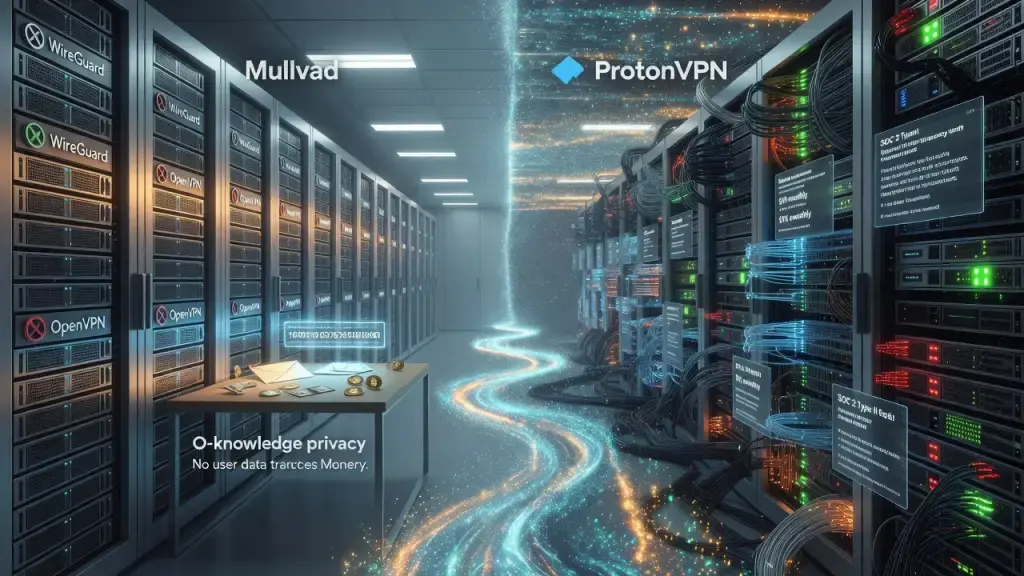
Mullvad's answer is architectural minimalism. Sign up and you receive a random 16-digit account number - no email, no name, no username. Pay with cash mailed to its Gothenburg office, or with Bitcoin or Monero, and the company never learns who you are. Even under legal compulsion, Mullvad has nothing to hand over beyond an account number and a credit balance. That is not a promise; it is a structural fact about how the system is built.
ProtonVPN takes a different route. It asks for an email address at sign-up, maintains account records, and has, through its sister service Proton Mail, complied with lawful Swiss orders in the past. What it offers instead is scale, audited transparency, and features that make privacy usable for people who also want to stream, work remotely, and move fast. Five consecutive annual audits by the security firm Securitum, plus a SOC 2 Type II attestation, give ProtonVPN a documented trail that Mullvad's zero-knowledge model, by design, cannot match.
Infrastructure and Speed Tell Different Stories
The server gap between the two is the starkest in the industry. ProtonVPN's network passed 20,000 servers in more than 140 countries by late 2026, up from roughly 15,800 across 126 countries a year earlier. A meaningful share of that footprint uses virtual server locations - physical machines that route traffic through an IP registered to a different country - a practice ProtonVPN discloses clearly in its apps.
Mullvad went the opposite direction. After retiring OpenVPN entirely on January 15, 2026, to focus exclusively on WireGuard, its server count fell to 582 machines across 50 countries. Every one of them is physical hardware - owned, co-located, or rented - with no virtual servers at all. For major markets like the United States, the UK, Germany, or Japan, that leaner footprint rarely matters. For obscure destinations, ProtonVPN's reach is a genuine advantage.
Speed tests from 2025 and 2026 favor ProtonVPN, with an average 16 percent overhead compared to Mullvad's 24 percent, though Mullvad has shown lower latency on some UK routes. Both now run on WireGuard as their core protocol, so the gap reflects routing and server management rather than any difference in encryption technology.
Protocol Shift Narrows Mullvad's Flexibility
Dropping OpenVPN was a deliberate trade. WireGuard is faster, leaner, and easier to audit, but it also offers fewer disguise options in places where VPN traffic itself is targeted by censors. ProtonVPN keeps OpenVPN, IKEv2, and a dedicated Stealth protocol built for circumventing network-level blocking - a meaningful edge for users in restrictive environments. Mullvad's bet is that a smaller, more auditable, WireGuard-only system is worth the lost versatility.
Pricing Reflects the Same Divide
Mullvad charges one flat rate, €5 a month, unchanged since 2009, with no discount for committing longer and no tiers to upsell into. ProtonVPN uses a conventional structure - a genuinely useful free tier with unlimited bandwidth but only one connection and no streaming, alongside a Plus plan priced around $10 monthly or discounted substantially on annual and two-year terms. At longer commitments, ProtonVPN often undercuts Mullvad on price even as Mullvad retains the edge on payment anonymity and freedom from any renewal obligation.
Neither service is the better choice in absolute terms. Someone worried about state-level surveillance and metadata correlation has little reason to look past Mullvad's refusal to collect identifying data in the first place. Someone who wants fast streaming access, broad global coverage, and a credible audit history will find ProtonVPN the more complete product. The honest conclusion is that both companies succeeded at what they set out to build - they simply built different things.